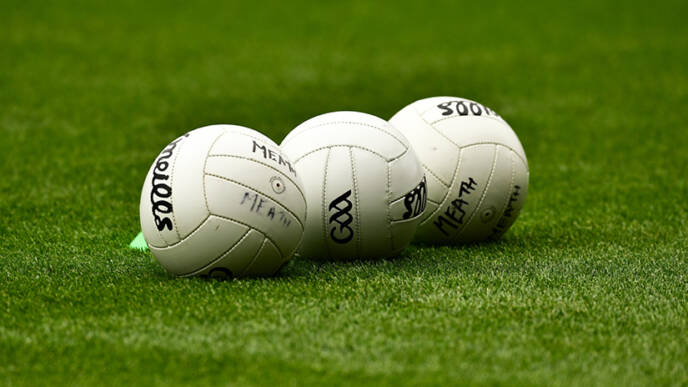
Ladies’ Gaelic football is a team sport for women, very similar to Mens Gaelic football, and co-ordinated by the International Governing Body, the Ladies’ Gaelic Football Association.
Two teams of 15 players kick or hand-pass a round ball towards goals at either end of a grass pitch with the winning team amassing the largest score.
Most of the rules of ladies’ gaelic football are the same as those for men’s game. The main differences are –
- A player may pick the ball up directly from the ground, so long as she is standing
- Most matches last 60 minutes
- Kickouts may be taken from the hand
- Changing hands: Throwing the ball from your right hand to left or vice versa.
- A countdown clock with siren is used if available; in the men’s game, the referee decides the end of the game
- All deliberate bodily contact is forbidden except when “shadowing” an opponent, competing to catch the ball, or blocking the delivery of the ball
- A smaller size 4 gaelic ball is used compared to the size 5 ball used in the men’s game.
Our member, the Provincial Council of Britain Ladies Gaelic Football Association is responsible for the regulation of competitions for girls from the age of 12 and above at club, county and university level.
The responsibility for the regulation of competitions for girls under the age of 12 falls to our member, the Provincial Council of Britain Gaelic Athletic Association.
In addition to delivering ladies gaelic football games in the traditional competition formats of league and championship; age specific and skill based games and competitions are also played with a view to developing players confidence and skills as they mature in their journey as a Ladies Gaelic Football player.
Examples of Ladies Gaelic Football coaching pathways are set out in the links below:
Small Sided Games, Gaelic 4 Girls, Ladies GaGa, Gaelic 4 mothers and others, Development Academies
All Britain Club Ladies Football Championship Roll of Honour:
Junior
1996 – Emerald Gaels, Lancashire
1997 – Emerald Gaels, Lancashire
1998 – Emerald Gaels, Lancashire
1999 – Emerald Gaels, Lancashire
2000 – Emerald Gaels, Lancashire
2001 – Emerald Gaels, Lancashire
2002 – Emerald Gaels, Lancashire
2003 – Emerald Gaels, Lancashire
2004 – Emerald Gaels, Lancashire
2005 – Tara, London
2006 – John Mitchels, Warwickshire
2007 – John Mitchels, Lancashire
2008 – John Mitchels, Lancashire
2009 – Kingdom Kerry Gaels, London
2010 – Oisins, Lancashire
2011 – Fulham Irish, London
2012 – Holloway Gaels, London
2013 – Dunedin Connolly’s, Scotland
2014 – Wolfe Tones, Lancashire
2015 – Oisins, Lancashire
2016 – Glasgow Gaels, Scotland
2017 – Kingdom Kerry Gaels, London
2018 – Roger Casements, Warwickshire
2019 – Oisins, Lancashire
2020 – Covid
2021 – Tir na Nog, Yorkshire
2022 – Hugh O’Neills, Yorkshire
2023 – Glasgow Gaels, Scotland
2024 – Wandsworth Gaels, London
2025 – St Kiernans, London
Intermediate
2010 – Parnells, London
2011 – Parnells, London
2012 – Parnells, London
2013 – Fr Murphys, London
2014 – Dunedin Connolly’s, Scotland
2015 – Dunedin Connolly’s, Scotland
2016 – Parnells, London
2017 – John Mitchels, Lancashire
2018 – Dunedin Connolly’s, Scotland
2019 – Parnells, London
2020 – Covid
2021 – Holloway Gaels, London
2022 – Round Towers, London
2023 – Tir Chonaill Gaels, London
2024 – Dunedin Connolly’s, Scotland
2025 – Holloway Gaels, London